An interview with George Marcu, MBA, CFA, MQF
In a financial world increasingly driven by data, algorithms and interconnected markets, the way investment ideas are researched and tested is changing. Traditional approaches that rely mainly on intuition or isolated market analysis are being challenged by more systematic, evidence-based methods.
This is the context in which we spoke with George Marcu, co-founder of Petanque Partners, a New York-linked investment research firm. After graduating from the University of Virginia’s Darden School of Business in 2023, Marcu chose not to follow the usual path into consulting or institutional finance. Instead, he set out to build a research platform that combines systematic trading, fundamental analysis and financial risk management — with a particular focus on liquid markets and the AI economy.
Money.ro conducted this interview to explore how a new generation of researchers approaches investment decision-making: why they start with options rather than stocks, how they decide when a strategy is robust enough to trade, and why some of the most valuable research outcomes come from the strategies they deliberately abandon. The conversation also sheds light on a longer-term ambition — creating a framework that connects information across equities, rates, credit, currencies and other markets, rather than studying them in isolation.
The common thread is decision-making under uncertainty: taking a large amount of financial information and turning it into a disciplined investment or risk decision.
Q: Why begin with options rather than simply building a stock portfolio?
GM: Options force you to be very precise. It isn't enough to say that the market will go up or down. You have to think about timing, the size of the move, the amount of capital you are willing to risk, what happens if you are wrong, and when you should exit.
We chose SPY as the initial market because it is highly liquid, heavily traded and closely connected to many of the themes we are interested in, particularly technology and AI. That makes it a good laboratory. There is enough activity to test ideas realistically, but the initial problem is still narrow enough that we can study it in depth.
We are currently concentrating on directional strategies that use options to express a view on whether a trend is strengthening or weakening.
Q: What does the research actually look for when deciding whether a market trend is meaningful?
GM: We start with fairly intuitive market information—price, trend, volatility and trading activity—and then ask whether those different measures tell a consistent story.
For example, moving averages can help indicate the direction and persistence of a trend, while Bollinger Bands show how far price has moved relative to its recent range. Volume adds another layer: a price move accompanied by stronger trading activity may carry different information from the same move on very light volume.
Those are simple examples, and they are not the strategy by themselves. In practice, we look at many indicators together and test whether they contain useful information across different market environments. The point is not to have one indicator tell you to buy or sell. It is to build a body of evidence and then decide how much conviction that evidence deserves.
That also affects how we put a position on. We don't necessarily deploy the entire position immediately. We can establish an initial exposure and increase it only if subsequent information strengthens the original thesis. Conviction is therefore something that can develop over time rather than something we assume at the outset.
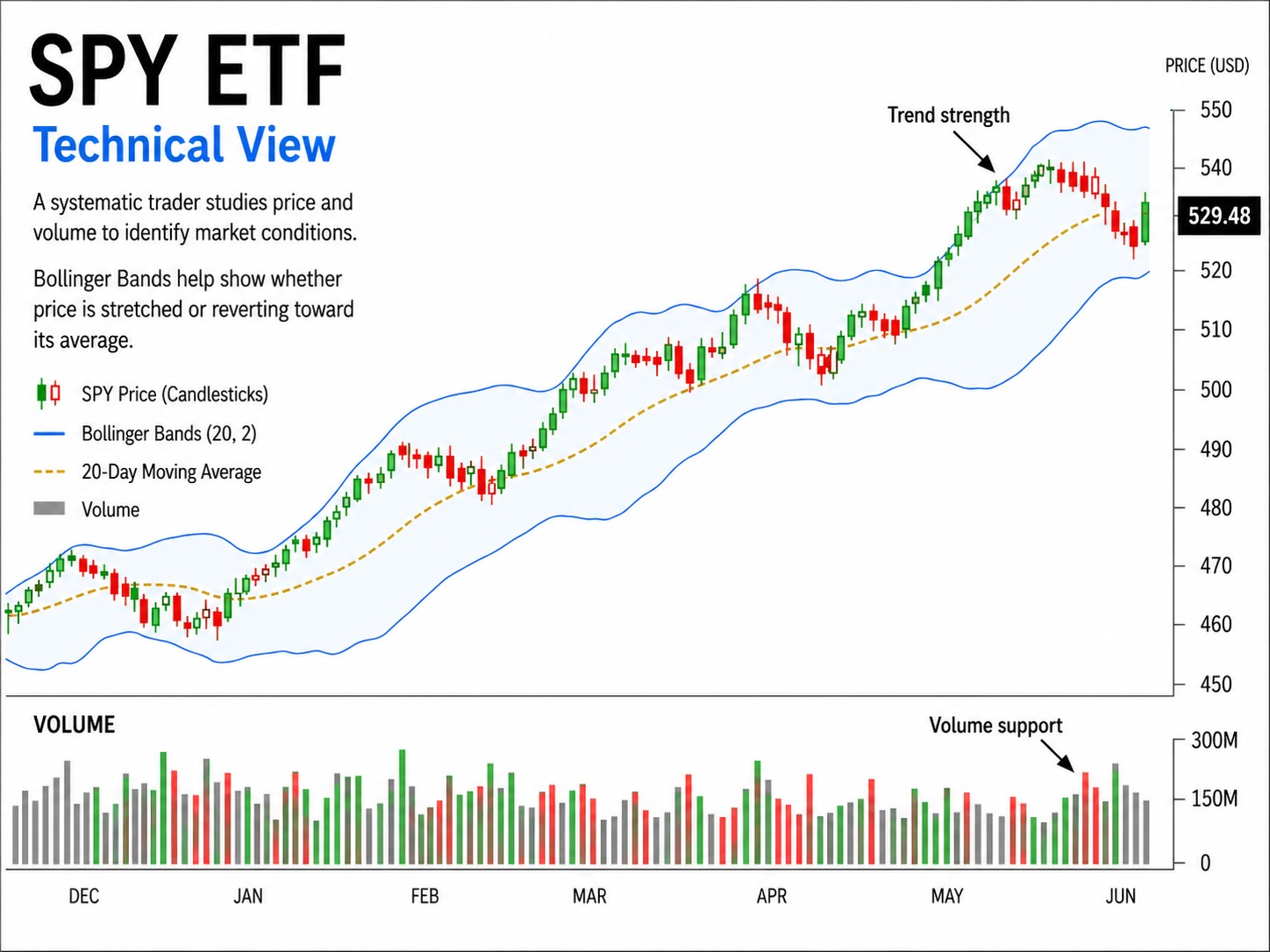
Price, trend, and trading volume are among the market inputs systematic investors can combine to assess whether a directional move is strengthening or weakening.
Q: Artificial intelligence is mentioned prominently in the firm's work. What role does it actually play?
GM: I see AI as a tool rather than an investment philosophy.
The objective isn't to say, "We use AI, therefore the strategy must work." The objective is to process information, identify relationships and update decisions more effectively than you could do manually.
Financial markets generate an extraordinary amount of information—prices, options, interest rates, currencies, commodities, company results, positioning and economic data. Some relationships are obvious and some are much more subtle. Machine learning can help identify which information matters, whether its importance is changing, and whether several signals are reinforcing or contradicting one another.
But the investment logic must come first: a more complicated model doesn't automatically make a better investment.
Q: How do you decide whether a trading idea works?
GM: We try very hard to prove that it doesn't. That's one of the most important lessons from the work so far. You can produce a historical test that looks very attractive and still has no durable investment strategy.
We initially spent considerable time investigating strategies built around collecting option premium. Some versions produced very strong headline backtests. But as we expanded the testing, incorporated realistic costs, examined different market conditions and imposed tougher standards, the evidence was not strong enough to justify deployment.
So, we changed gears. What survived was more valuable: the market data infrastructure, the risk framework, the testing process and a much better understanding of what the strategy needs to accomplish. The current research is more focused on directional opportunities where the potential loss can be defined in advance.
Q: So, abandoning a strategy isn't considered a failure?
GM: Of course not. Quite the opposite.
If your research process never tells you to abandon anything, I would be concerned about the research process.
Markets contain enormous amounts of historical information, which means it is surprisingly easy to find something that appears to have worked in the past. The challenge is determining whether you have found an economic relationship or simply an attractive coincidence.
For me, the objective isn't to defend an idea because we have already spent six months on it. The objective is to find something that deserves capital.
Q: Petanque also does fundamental research. How does that fit with systematic trading?
GM: I don't see the two approaches as contradictory.
For example, we have researched the AI economy as a chain rather than simply looking at a group of technology stocks. That includes semiconductors, cloud and data-center infrastructure, data, foundation models and the applications built on top of them.
Fundamental research asks where value is being created, who is spending money, who receives it, where capital investment is increasing and where the economics may be misunderstood. Systematic research, on the other hand, asks whether those developments can be observed in financial markets and incorporated into repeatable decisions.
Eventually, I would like those two perspectives to communicate with each other much more extensively.
Q: You describe markets as interconnected. How would that change the way investment research is done?
GM: The long-term idea is that financial markets should not be studied as isolated silos.
A move in equities may contain information about credit. Changes in interest rates can affect currencies, real estate and stock valuations. Commodity prices can influence inflation expectations, corporate margins and monetary policy. Capital is constantly moving through the financial system, and those movements often leave traces in more than one market.
What we ultimately want is a common research framework that can collect those different signals, compare them and make relevant information available across the investment process.
So, instead of an equity strategy looking only at equity information, it could also understand what is happening in rates, credit, currencies, commodities or volatility when those markets are relevant to the decision.
The important part is the flow of information: data enters from different sources, it is analyzed in a common research framework, and the resulting insights can then inform trading, portfolio construction and risk management. The ambition is to create better context around each individual investment decision rather than treating every market in isolation.
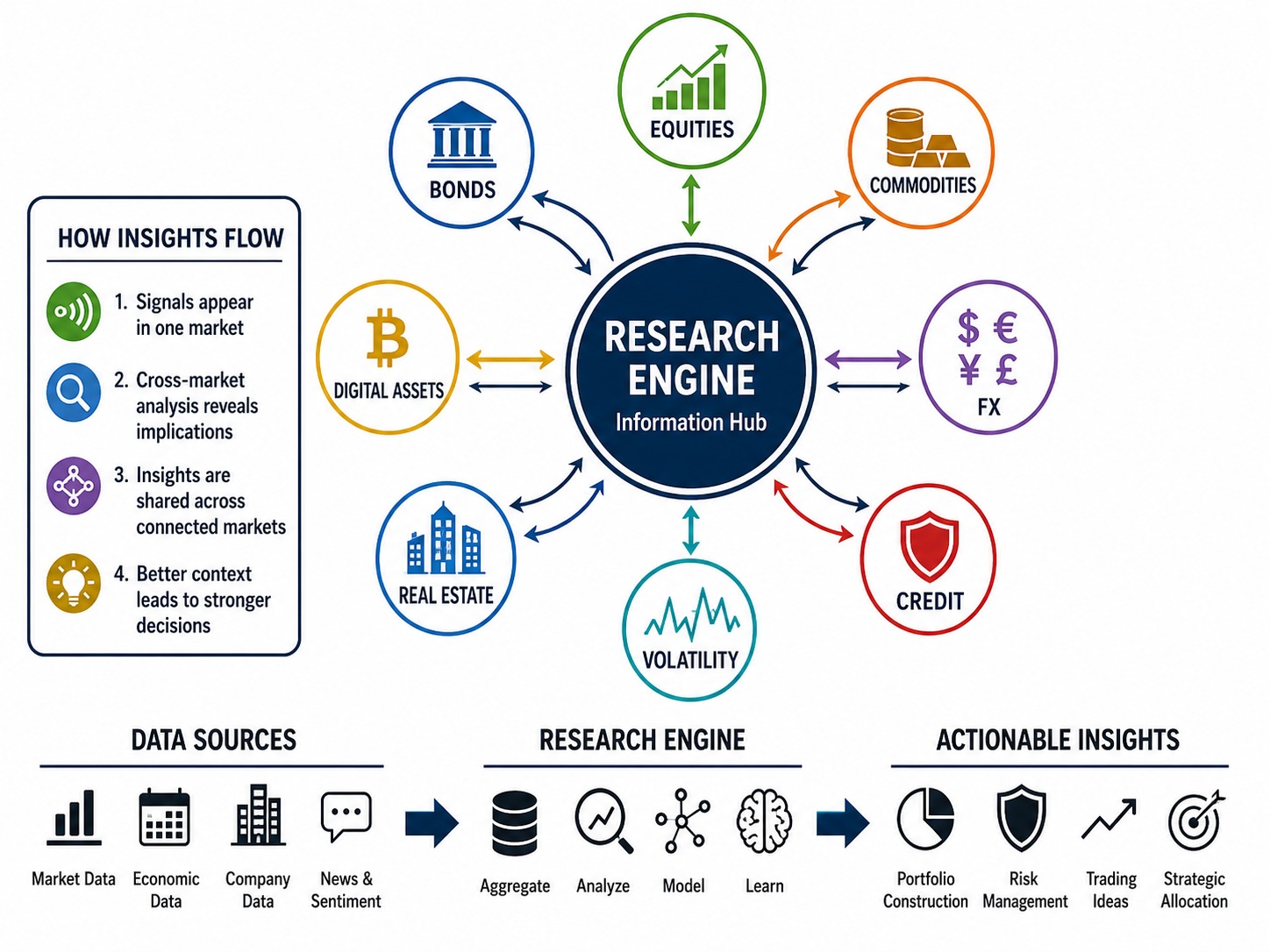
A common research framework can bring information from different markets together, allowing signals in equities, bonds, currencies, commodities and other assets to inform broader investment decisions.
Q: What does success ultimately look like for Petanque Partners?
GM: In the near term, success means producing investment research that survives serious testing and building a process that can be repeated.
Longer term, the ambition is to create an investment platform where information across markets is treated as a shared resource and where systematic methods help reduce avoidable human bias.
But I think the order matters. You first need evidence. Then you need a track record. Then you earn the right to scale. We're still building that first foundation.