Artificial intelligence is often discussed as a purely digital phenomenon — a story of algorithms, models and software. For investors, however, it is increasingly becoming an industrial and geopolitical one.
In this analysis, George Marcu, MBA, CFA, MQF, examines how strategic events — from the Strait of Hormuz to tensions surrounding Taiwan — transmit through the physical AI supply chain and ultimately reach financial markets. The article argues that disturbances in energy, shipping, specialty materials or manufacturing capacity do not remain isolated. They move through prices, inventories, financing conditions and company valuations, often with a lag.
Written for Money.ro, the piece offers a practical framework for reading these multi-stage information processes. Instead of treating geopolitical headlines as binary risks (rise or fall), Marcu proposes watching a sequence of markets — from commodities and rates to semiconductor suppliers and AI platforms — to understand how capital and risk actually travel through the system.
The central message is straightforward: AI may be digital at the point of use, but its supply chain is intensely physical. Understanding that chain is now essential for technology investors.
The Physical AI Economy
Artificial intelligence is usually presented as a story of technology. For investors, it is increasingly an industrial one.
A modern AI system begins with semiconductor equipment, specialty chemicals and gases, moves through wafer fabrication, advanced packaging and memory, and eventually reaches servers, power infrastructure, data centers, cloud platforms and software. The physical chain spans the United States, Taiwan, South Korea, Japan, Europe, China and the Middle East.
That geography matters because strategic events rarely affect the entire chain at once. They enter through a particular point—energy, shipping, materials, export controls or manufacturing capacity—and then move outward through prices, inventories, investment decisions and ultimately financial markets.
The current U.S.-Iran confrontation, the Russia-Ukraine conflict, and developments surrounding China and Taiwan are therefore not separate stories for technology investors. These are different examples of the same underlying question: how does a disturbance in one part of the global economy transmit into the AI investment cycle?
The answer begins by looking beyond the chip itself.
How Shocks Move
Consider the Strait of Hormuz. It does not manufacture GPUs, yet before the current confrontation the waterway carried roughly one-fifth of global oil and LNG transport. Shipping remains materially below normal levels: Reuters reported only six commodity-carrying vessels passing through the strait on July 27, while regional governments continue discussing arrangements for more predictable transit.
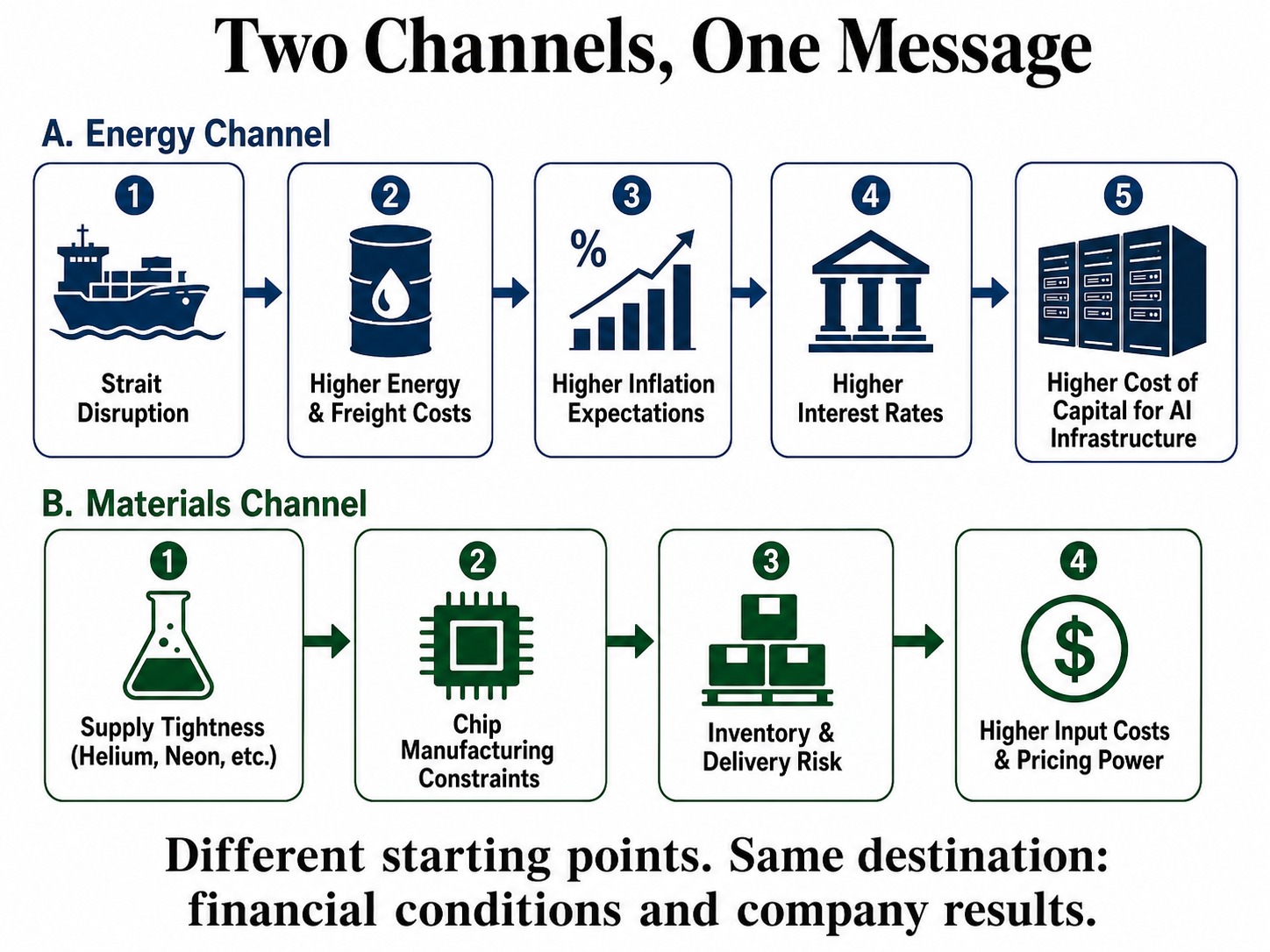
Different starting points; same destination: financial conditions and company results.
For the technology industry, the first transmission channel is obvious: energy. AI infrastructure is becoming one of the most electricity-intensive areas of capital investment. The International Energy Agency projects global data-center electricity consumption to more than double to about 945 terawatt-hours by 2030, with AI-focused accelerated servers accounting for almost half of the increase.
Natural gas is expected to provide a meaningful part of the additional generation required. An interruption in Gulf energy flows can therefore travel much further than the oil market. Energy prices influence inflation expectations; inflation expectations affect interest rates; and rates affect the financing cost and valuation of a technology sector that is becoming increasingly capital intensive.
The second channel is less visible: specialty materials. In March, South Korean semiconductor executives focused on helium supplies following interruptions to Qatari LNG production. Qatar produces close to one-third of global helium, which is recovered during natural-gas processing and is used in semiconductor manufacturing. Reuters subsequently reported sharp increases in helium prices as Qatari output stopped.
This is not unprecedented: when the Russia-Ukraine conflict began in 2022, Ukraine supplied an estimated half of world neon production and nearly all of the ultra-high-purity semiconductor-grade neon imported by the United States. Neon is required for lasers used in semiconductor manufacturing.
That distinction—small input, large downstream dependency—is one of the defining characteristics of the semiconductor industry.
Taiwan illustrates it at a much larger scale: semiconductor fabrication requires not just fabs, but skilled labor, electricity, chemicals, gases, equipment, logistics and customer qualification. Many chemicals cannot simply be stockpiled indefinitely. Replicating Taiwan's manufacturing ecosystem elsewhere is a long-term process rather than a rapid transfer of capacity.
A selective maritime restriction can affect insurance, shipping times, energy or particular materials while fabrication continues. A broader restriction changes the set of constraints. The financial consequences therefore depend on both the nature and duration of the event, rather than merely whether an event has occurred.
There is another dimension: strategic restrictions can alter the supply chain itself.
The Huawei experience is instructive. Restrictions on access to advanced semiconductor technology encouraged Huawei to increase internal development and work more closely with domestic suppliers, including SMIC. The result was not simply a change at Huawei; information about the new supply arrangement propagated through the prices of companies connected to the two firms.
That matters beyond Huawei. It suggests that markets do not always price a supply-chain event as one instantaneous adjustment. Investors first understand the event, then identify which companies are exposed to it, and then revise expectations about revenues, costs, competitive position and future capacity.
That is closely related to an older finding in financial research: information can travel between markets with a lag.
Research found that oil-price movements historically carried information for subsequent equity returns, with lagged oil measures sometimes stronger than contemporaneous ones. The historical sample predates the shale era, so the relationship should not be treated as a mechanical trading rule, but the broader principle remains useful: the market receiving the information first need not be the asset ultimately most affected by it. Moreover, large index moves tend to cluster around identifiable macro information, while the source of the move can contain information about what happens to volatility afterward.
This creates a more useful framework for reading strategic events than simply asking whether markets should rise or fall.
Hormuz may first appear in oil, LNG, freight and insurance. From there it can enter inflation expectations and bond yields. At the industry level it can affect industrial gases, power economics and data-center financing. Only afterward may the full implications appear in technology-sector earnings expectations.
A Taiwan-related event would likely follow a different path. Shipping rates, insurance, Asian currencies, and semiconductor names could become the first information markets. The next layer would be memory, packaging, equipment suppliers, and customer inventories. If the event persisted, cloud providers and AI developers would eventually face questions about delivery schedules and computing capacity.
Export controls create another pattern altogether: the initial impact falls on accessible technology and revenues, while the longer-term response may be investment in domestic substitutes. China continues to invest in semiconductor manufacturing and critical-material independence, while the United States is simultaneously expanding alternative rare-earth supply and tightening controls around sensitive technologies. The relevant variable is therefore not simply disruption; it is adaptation.
What Markets Price Next
For investors, the practical implication is that strategic events should be treated as multi-stage information processes, not isolated headlines.
In the present Middle Eastern environment, one possible market sequence is straightforward. If restricted Hormuz traffic persists, energy and transportation costs remain the first variables to watch. If those prices feed into inflation expectations and yields, highly capital-intensive parts of the AI ecosystem become increasingly sensitive to financing conditions. That matters at a moment when AI infrastructure is already requiring much greater external capital: for example, Meta's newly announced El Paso data-center venture, for example, combines equity participation with more than $12 billion of debt financing.
The reverse sequence is equally important. A normalization of shipping can reduce oil and rates quickly, even while physical inventories, contracts and production systems take much longer to adjust. The technology index may therefore reprice before the industrial chain has returned to its previous configuration.
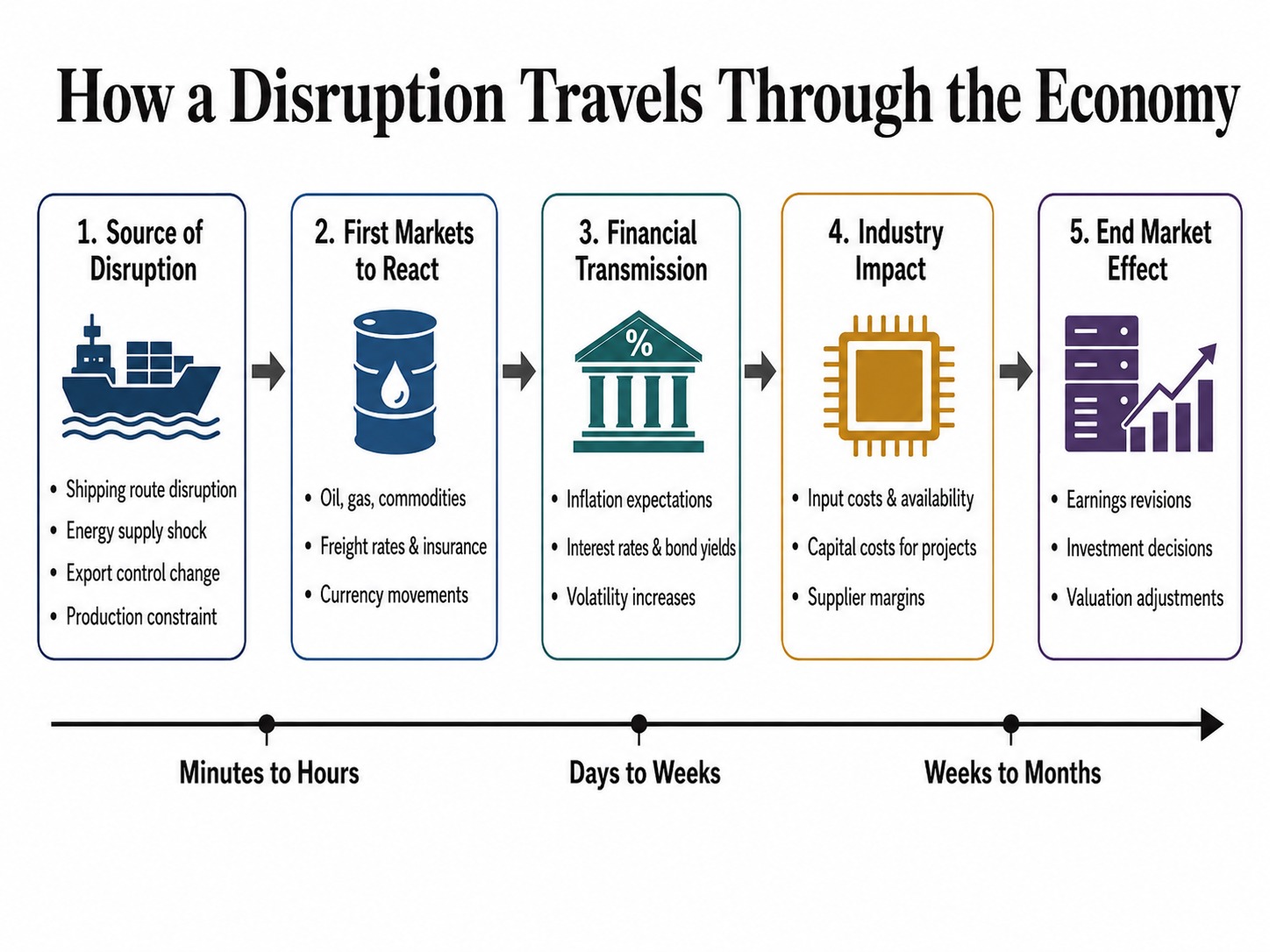
Information enters at the source, but the full impact usually appears farther down the chain. And with a delay.
In conclusion, for any strategic event, I would watch five markets in order: transportation and commodities; inflation and rates; volatility and currencies; upstream semiconductor suppliers; and, finally, the major AI platforms and their capital-spending plans. The signal becomes more persuasive when several parts of that chain move in the same direction.
That may ultimately be the larger investment lesson of the AI era. The technology industry can no longer be understood exclusively through software adoption, chip performance or model capability. Its economics increasingly depend on energy markets, industrial capacity, shipping routes, financial conditions and government policy.
AI may be digital at the point of use; its supply chain is very physical.