The UAE’s Silent Bond Revolution
In this article, George Marcu, MBA, CFA, MQF, analyzes the silent revolution of the UAE bond market — a process that began in 2022 with the first dirham-denominated bond auction and has since profoundly transformed the regional financial landscape. The article traces how the UAE has steadily built the infrastructure needed to borrow in its own currency, while simultaneously creating essential benchmark instruments for the entire region.
Written for Money.ro, the piece explains why the main purpose behind this move was not simply to raise capital, but to introduce a key monetary and financial policy instrument. Marcu details how dirham-denominated sovereign bonds can serve as a reference point for the local market — including for instruments compliant with Islamic principles, known as sukuk — and how the yield spread relative to conventional securities has proven surprisingly narrow.
The central message is that what appears to be a technical treasury decision is in fact a strategic move of considerable scale: the UAE is not merely building a yield curve, but laying the foundations of a truly sovereign regional financial center.
Content published on money.ro may be reproduced, in accordance with applicable legislation, only within a limit of 450 characters. Details at: https://www.money.ro/termeni-si-conditii/
Over the last few years, the UAE has quietly laid the groundwork for financial sector expansion that, at first glance, appears unusual for the Gulf’s famous state: creating a debt market that would allow it to borrow in its own currency. However, the main purpose behind this endeavor is not to simply raise capital, but to introduce one important instrument specific to mature financial markets: a dirham-denominated sovereign yield curve.
Even before 2022, the UAE was rapidly becoming an important player in the global debt market. According to its Ministry of Finance, the federal government issued debt worth $4 billion in October 2021 and another $3 billion through a dual-tranche dollar offering in 2022, in addition to substantial issuance by UAE’s banks, government-related entities, and corporations. However, building on legislation adopted in 2018, four years later the federal authorities decided to pursue something much bolder. In this regard, they set out on developing the local debt market and constructing a UAE dirham-denominated yield curve that can serve as a reference for financial products.
Building the Dirham Curve
As such, May 11, 2022, will be remembered as the moment the UAE bond revolution took place. On that date, the first federal dirham Treasury bond auction took place. Exactly one year later, the UAE government auctioned its first dirham Treasury sukuk, which is a fixed-income instrument that is fully compliant with Islamic finance principles and is available for investment to Islamic financial institutions and Sharia-sensitive portfolios (sukuk, in turn, can also be distinguished between asset-backed and asset-based).
This milestone is very important for UAE’s expanding capital markets because, by the end of 2025, the government had conducted eight Treasury bond auctions, issuing AED11.2 billion cumulatively, and 23 Treasury sukuk auctions, issuing another AED27 billion. Although cumulative issuance of AED38.2 billion (roughly $10.4 billion) remains modest compared to major sovereign debt markets, the primary purpose of the program is market-building rather than budgetary financing
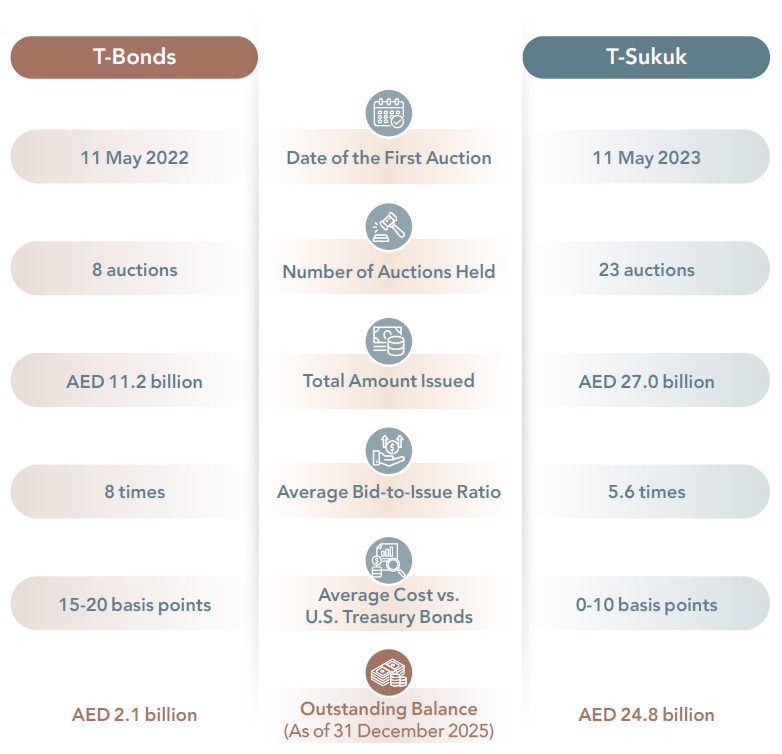
UAE’s Treasury bond and sukuk programs as of December 31, 2025.
Source: UAE Ministry of Finance
In this context, 2026 appears consequential since, in January, the government launched its first new Treasury bond tranche since March 2023, which is due to mature in 2031. Soon after, in February, it added the first seven-year Treasury sukuk, extending the AED curve to 2033; the AED550 million tranche drew about AED3.1 billion of bids (thus, a very favorable 5.6-to-1 ratio). In April, a further issuance of that seven-year line was priced at a 4.13% yield, only 10 basis points over comparable US Treasuries while, in July, combined bond and sukuk auctions drew again more than four times the amount offered.
Borrowing without a deficit
So why is the UAE interested in developing a dirham-denominated sovereign debt market in the face of both dollar debt supremacy and consistent budgetary surpluses?
As for access to dollar funding, not only is dollar-denominated debt easily available to UAE’s government, but also that its local currency is pegged to the US dollar which limits currency volatility. International dollar markets also offer greater depth and a broader institutional investor base.
As for the budgetary structure present at UAE’s federal level, it should be remembered that, unlike most other countries, the annual federal budget does not rely on public debt to finance expenditure. Instead, proceeds from sovereign issuance are invested under a portfolio mandate managed by the Ministry of Finance and Emirates Investment Authority whose purpose is capital preservation and duration matching. At the broader general-government level, the IMF estimated the fiscal surplus at 6.4% of GDP in 2024 and projected it to remain around 5% in 2025–26.
Which brings us to the crux of the matter: the purpose behind this endeavor. In this regard, one must also look at a much-cited 2004 NBER working paper by Barry Eichengreen and Pipat Luengnaruemitchai, in which they identify the existence of a well-defined yield curve and the adequacy of trading, settlement and clearing infrastructure as ingredients of successful bond-market development. Both authors also crucially point out that strong fiscal balances, desirable for obvious reasons, can actually impede government-bond-market development because governments simply have less reason (and incentives) to issue debt.
In our case, the UAE is deliberately supplying benchmark securities despite lacking the chronic deficit-financing imperative familiar in many developed sovereign markets. This makes the program even more consequential as the government is effectively bearing the cost of maintaining benchmark securities because their value to the wider financial system may exceed the financing proceeds themselves.
However, the UAE government considered that the cost for such action was worth it once the primary purpose of a domestic yield curve is recalled, namely that it represents the price list of money over time. In other words, the yield curve defines how much a relatively low-risk borrower (e.g. the federal government) must pay to borrow for medium- to long-term maturities. This benchmark is critical for borrowers as they can price their own debt relative to the different yields (e.g., a bank may borrow at the sovereign rate plus an issuer-specific credit spread, while a riskier or less liquid infrastructure borrower would generally have to pay a wider spread). In the absence of such a yield curve, investors must infer the appropriate required yield from dollar securities, swaps, bank lending rates, or comparable foreign issuers, which makes price discovery less direct.
Putting a price on risk
A practical example followed quickly. In January 2023, Emirates NBD issued AED1 billion of three-year notes (the notes carried a 5.125% coupon and were priced 83 basis points over UAE Federal Treasury Bonds). The same logic could later be extended farther along the curve: for example, a UAE infrastructure company with seven-year dirham cash flows would no longer need to rely exclusively on syndicated loans or dollar-denominated issuance when it can now price a seven-year AED security at the federal 2033 benchmark level plus a specific spread. In other words, the price of issuer-specific risk becomes more transparent.
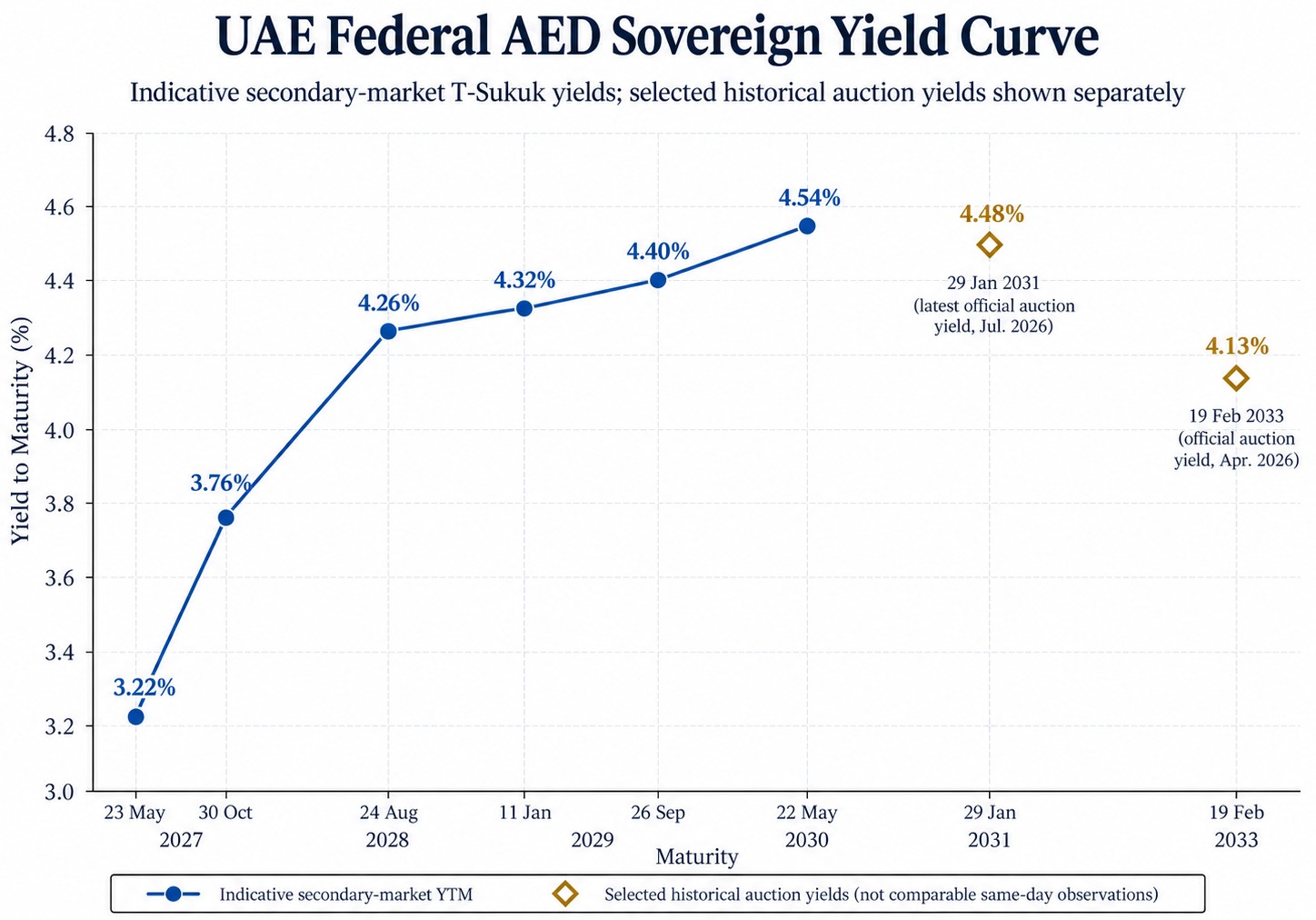
That is why the government has pursued this debt-market expansion: not merely to introduce domestic sovereign fixed-income benchmarks, but to improve price discovery for mortgages, capital projects and private-sector funding, and ultimately to make capital allocation more transparent.
It is equally true that the harder phase begins now: a successful sovereign curve should eventually encourage more UAE banks and corporations to borrow directly in dirhams, to issue larger benchmark-sized securities, and to generate meaningful secondary-market turnover (price discovery remains limited when investors purchase government securities and hold them until maturity). The ultimate test of the UAE's bond experiment, therefore, will not be how heavily its Treasury auctions are oversubscribed, but how many private-sector financial decisions eventually come to be priced against the curve they created.